

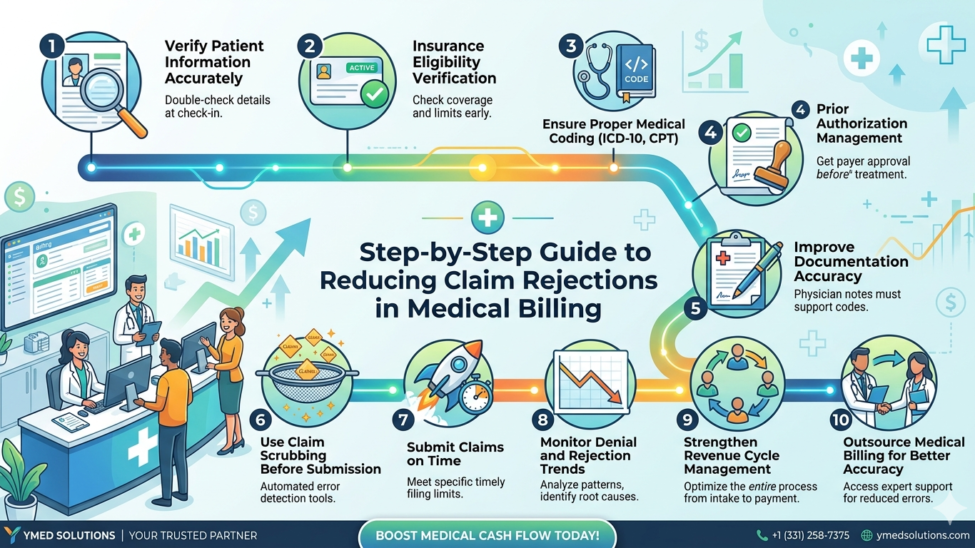
Step-by-Step Guide to Reducing Claim Rejections in Medical Billing
How Efficient Billing Systems Prevent Claim Rejections in Healthcare
Claim rejections are one of the biggest challenges in the healthcare revenue cycle. Every rejected claim means delayed payments, increased administrative workload, and reduced cash flow for doctors, clinics, and home health agencies. In this comprehensive guide, we will walk you through a step-by-step process to reduce claim rejections in medical billing and improve your revenue cycle efficiency.
Understanding Claim Rejections in Medical Billing
A claim rejection occurs when an insurance company or clearinghouse refuses to process a claim due to errors or missing information. Unlike denials, rejected claims never reach final adjudication. This makes prevention extremely important.
According to industry reports, most rejections are caused by avoidable errors such as incorrect patient data, eligibility issues, and coding mistakes.
Get Expert Billing Support Today
📞 +1 (331) 258-7375Why Claim Rejections Matter for Healthcare Providers
- Delayed reimbursements
- Increased accounts receivable (AR) days
- Higher administrative workload
- Loss of revenue due to timely filing limits
Healthcare providers such as clinics and home health agencies often struggle when claim rejections are not managed properly. That is why professional support systems like Revenue Cycle Management are critical for long-term financial stability.
Step 1: Verify Patient Information Accurately
The first and most important step in reducing claim rejections is ensuring accurate patient data collection at the front desk.
Common errors include:
- Incorrect spelling of patient name
- Wrong date of birth
- Invalid insurance ID numbers
- Missing subscriber details
Even a small typo can lead to immediate rejection by the payer system.
Stop Claim Rejections Now
✉ info@ymedsolutions.comStep 2: Insurance Eligibility Verification
Eligibility issues are one of the top reasons for claim rejections in medical billing. Always verify insurance coverage before patient visits.
Best practices include:
- Real-time eligibility checks
- Verification of primary and secondary insurance
- Checking plan coverage limitations
To improve accuracy, many providers rely on professional services like Medical Billing Services.
Step 3: Ensure Proper Medical Coding (ICD-10, CPT)
Coding errors are a major cause of claim rejections. Incorrect ICD-10 or CPT codes can lead to instant rejection or delayed processing.
Common coding mistakes include:
- Using outdated codes
- Incorrect code pairing
- Missing modifiers
- Unbundling services incorrectly
Accurate coding is essential for clean claims and faster reimbursement.
Learn more about coding accuracy here: Medical Billing and Coding Solutions
Improve Your Clinic Revenue Fast
📞 Call Now: +1 (331) 258-7375Step 4: Prior Authorization Management
Many claims are rejected due to missing or incorrect prior authorizations. Certain procedures require payer approval before services are provided.
Best practices:
- Verify authorization before treatment
- Match CPT codes with approved procedures
- Track authorization expiry dates
Step 5: Improve Documentation Accuracy
Clinical documentation plays a critical role in claim acceptance. Missing or incomplete documentation often leads to rejection.
Ensure that:
- All services are properly documented
- Medical necessity is clearly stated
- Physician notes support coding
Visit Our Medical Billing Office
📍 122 W St Charles Rd, Villa Park, ILStep 6: Use Claim Scrubbing Before Submission
Claim scrubbing helps detect errors before claims are submitted to payers.
This process identifies:
- Missing patient details
- Invalid codes
- Formatting issues
This step significantly reduces rejection rates and improves clean claim submission rates.
Step 7: Submit Claims on Time
Late submissions are one of the most common reasons for claim rejection. Every insurance payer has strict timely filing limits.
To avoid issues:
- Submit claims within 24–72 hours
- Avoid backlog in billing systems
- Track claim submission deadlines
Boost Medical Cash Flow Today
info@ymedsolutions.comStep 8: Monitor Denial and Rejection Trends
Tracking patterns in claim rejections helps identify recurring issues. This is a key part of effective revenue cycle management.
For advanced support, explore Denial Management Services.
Step 9: Strengthen Revenue Cycle Management
A strong revenue cycle system ensures smooth financial operations from patient intake to final payment.
Key components include:
- Patient registration accuracy
- Medical coding compliance
- Claim submission tracking
- Payment posting and reconciliation
Learn more here: Revenue Cycle Management Solutions
Outsource Medical Billing Now
📞 Call Experts NowStep 10: Outsource Medical Billing for Better Accuracy
Many clinics and home health agencies choose outsourcing to reduce claim rejections and improve cash flow efficiency.
Benefits include:
- Reduced billing errors
- Faster reimbursements
- Expert coding support
- Improved compliance
Explore services: Professional Medical Billing Services
Common Causes of Claim Rejections
- Incorrect patient demographics
- Insurance eligibility issues
- Missing documentation
- Invalid CPT/ICD codes
- Late claim submission
Fix Claim Issues With Experts
Open Location in Google MapsBest Practices to Prevent Claim Rejections
- Train front desk staff regularly
- Use automated billing systems
- Conduct regular audits
- Improve communication between departments
Conclusion
Reducing claim rejections in medical billing requires a structured, step-by-step approach. From patient registration to coding accuracy and claim submission, every stage of the revenue cycle must be optimized.
Healthcare providers who implement strong billing workflows experience fewer rejections, faster payments, and improved financial stability.
To get expert assistance, visit YMED Solutions or contact their team directly at Contact Page.
Increase Approvals And Payments
Contact Us NowFAQs
What is the main cause of claim rejections?
Most claim rejections occur due to incorrect patient information, eligibility issues, or coding errors.
How can clinics reduce claim rejections?
By improving front desk verification, coding accuracy, and using claim scrubbing tools.
What is the difference between rejection and denial?
Rejections happen before processing; denials occur after payer review.


