

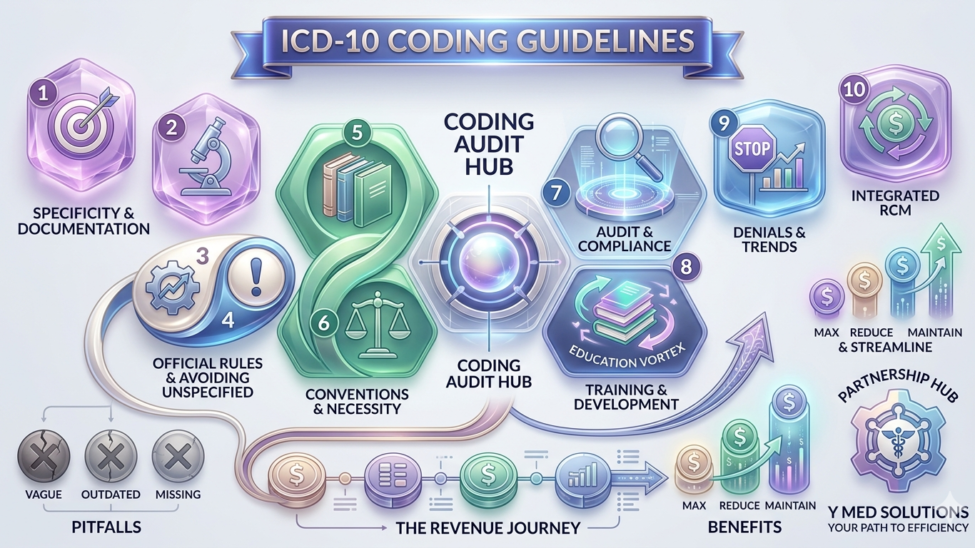
Best ICD-10 Coding Guidelines for Medical Practices
ICD-10 Coding Guidelines Every Medical Practice Should Follow
Accurate medical coding is the foundation of a successful healthcare revenue cycle. Whether you operate a private practice, specialty clinic, urgent care center, or large healthcare organization, following proper ICD-10 coding guidelines is critical for ensuring accurate reimbursements, reducing claim denials, and maintaining regulatory compliance.
As healthcare regulations continue to evolve, medical providers must stay updated with the latest coding standards to avoid costly mistakes. At Y Med Solutions, we help healthcare organizations improve coding accuracy, compliance, and revenue performance that can negatively impact revenue and patient care. In this comprehensive guide, we’ll explore the essential ICD-10 coding guidelines every medical practice should follow and how partnering with experienced medical billing and coding professionals can improve operational efficiency.
What Is ICD-10 Coding?
The International Classification of Diseases, Tenth Revision (ICD-10), is a standardized coding system used by healthcare providers, insurance companies, and government agencies to classify diagnoses, symptoms, and medical conditions.
ICD-10 codes serve several important purposes:
- Support accurate medical billing
- Justify medical necessity
- Facilitate insurance reimbursement
- Improve healthcare reporting
- Ensure regulatory compliance
- Support clinical documentation
Proper ICD-10 coding is essential for maintaining a healthy revenue cycle and avoiding unnecessary claim denials.
Visit Us Today
122 W St Charles Rd, Villa Park, IL 60181, USA
Why Accurate ICD-10 Coding Matters
Even minor coding errors can lead to significant financial losses for healthcare organizations. Incorrect diagnosis codes may result in:
- Delayed reimbursements
- Increased claim denials
- Compliance violations
- Revenue leakage
- Audit risks
- Patient billing disputes
This is why many healthcare providers rely on professional Medical Billing and Coding Services to ensure coding accuracy and maximize reimbursements.
Essential ICD-10 Coding Guidelines Every Practice Should Follow
1. Code to the Highest Level of Specificity
One of the most important ICD-10 coding principles is selecting the most specific diagnosis code available.
Instead of using general diagnosis codes, providers should document detailed clinical information, including:
- Disease severity
- Anatomical location
- Laterality (left, right, bilateral)
- Associated complications
- Episode of care
Specific coding improves claim acceptance rates and reduces payer inquiries.
Email Us Now
info@ymedsolutions.com2. Always Verify Clinical Documentation
Coding should never be based on assumptions.
Coders must review complete clinical documentation before assigning diagnosis codes. The provider’s notes should clearly support every diagnosis reported on the claim.
Strong documentation helps:
- Prevent coding errors
- Improve reimbursement accuracy
- Reduce audit risks
- Support medical necessity
3. Follow Official Coding Guidelines
The Centers for Medicare & Medicaid Services (CMS) and industry coding authorities publish annual ICD-10 updates and coding instructions.
Healthcare organizations should establish processes to:
- Review annual code updates
- Train coding staff regularly
- Monitor payer-specific requirements
- Update coding software
Keeping current with coding changes prevents outdated code usage that can lead to denied claims.
Call Now – We’re Here to Help
+1 (331) 258-73754. Avoid Unspecified Codes Whenever Possible
While unspecified diagnosis codes may occasionally be necessary, overusing them can trigger claim denials and reimbursement delays.
Insurance payers increasingly expect providers to submit detailed and specific diagnosis information whenever available.
Providers should document enough clinical detail to allow coders to select the most accurate ICD-10 code.
5. Understand Coding Conventions
ICD-10 includes several coding conventions that must be followed carefully:
Laterality
Many diagnosis codes specify whether a condition affects:
- Left side
- Right side
- Bilateral structures
Combination Codes
Some ICD-10 codes capture multiple conditions within a single code.
Placeholder Characters
Certain codes require placeholder characters to maintain proper formatting.
Ignoring these conventions can result in coding inaccuracies and rejected claims.
6. Ensure Medical Necessity Is Supported
Call Us Anytime
+1 (331) 258-7375Insurance carriers review claims to determine whether services provided were medically necessary.
The diagnosis code must support:
- Procedures performed
- Diagnostic tests ordered
- Treatments rendered
Failure to establish medical necessity is one of the leading causes of claim denials.
Practices that implement strong Denial Management strategies often experience faster reimbursements and lower denial rates.
7. Regularly Conduct Coding Audits
Internal coding audits help identify:
- Documentation deficiencies
- Coding inaccuracies
- Compliance risks
- Revenue loss opportunities
Routine audits allow practices to correct issues before they become costly problems.
Benefits of coding audits include:
- Improved compliance
- Better reimbursement rates
- Reduced payer scrutiny
- Enhanced staff education
Call Now – Limited Support Available
+1 (331) 258-73758. Train Providers and Coding Staff
Successful ICD-10 coding starts with provider documentation.
Physicians, nurse practitioners, and healthcare staff should receive ongoing training regarding:
- Documentation requirements
- Coding updates
- Compliance regulations
- Payer policies
Investing in education improves coding accuracy throughout the organization.
9. Monitor Claim Denials Related to Coding
Tracking coding-related denials helps practices identify recurring issues.
Common coding-related denial reasons include:
- Invalid diagnosis codes
- Missing diagnosis information
- Lack of medical necessity
- Mismatched diagnosis and procedure codes
- Outdated ICD-10 codes
Analyzing denial trends enables healthcare organizations to implement corrective measures quickly.
Speak With Our Team
+1 (331) 258-737510. Integrate Coding with Revenue Cycle Management
Medical coding directly affects every stage of the reimbursement process.
Accurate coding improves:
- Claim acceptance rates
- Revenue collection
- Accounts receivable performance
- Cash flow management
Organizations that align coding practices with comprehensive Revenue Cycle Management strategies often achieve stronger financial outcomes.
Common ICD-10 Coding Mistakes to Avoid
Healthcare providers frequently encounter these coding errors:
Using Outdated Codes
ICD-10 codes are updated annually. Failure to update code sets can result in rejected claims.
Coding Without Documentation Support
Every diagnosis code must be fully supported by clinical documentation.
Selecting General Codes
Using vague or unspecified codes can delay reimbursement.
Missing Laterality Information
Many diagnosis codes require left, right, or bilateral identification.
Ignoring Coding Updates
Staying informed about annual coding revisions is essential for compliance.
Get Instant Assistance
+1 (331) 258-7375How Professional Medical Billing and Coding Services Help
Managing ICD-10 coding internally can be challenging, especially for busy healthcare practices.
Professional Medical Billing Services provide:
- Certified coding expertise
- Accurate claim submission
- Denial prevention strategies
- Compliance monitoring
- Revenue optimization
- Faster reimbursements
Outsourcing coding and billing functions allows providers to focus on patient care while improving financial performance.
The Role of Credentialing in Accurate Billing
Accurate coding alone is not enough. Providers must also be properly enrolled and credentialed with insurance payers.
Credentialing ensures:
- Network participation
- Timely reimbursements
- Reduced billing delays
- Compliance with payer requirements
Many healthcare organizations combine coding support with comprehensive Credentialing Services to streamline operations.
Why Choose Y Med Solutions?
At Y Med Solutions, we specialize in helping healthcare providers maximize revenue through accurate coding, efficient billing, and proactive denial management.
Our services include:
- Medical Billing Services
- Medical Billing and Coding
- Revenue Cycle Management
- Denial Management
- Credentialing Services
Our experienced team stays current with the latest ICD-10 updates and industry regulations to help practices reduce denials, improve claim accuracy, and achieve sustainable growth.
Learn more About Us and discover how our healthcare revenue experts can support your practice.
Final Thoughts
ICD-10 coding accuracy is essential for maintaining compliance, minimizing claim denials, and optimizing healthcare revenue. By following these coding guidelines, healthcare organizations can improve operational efficiency, strengthen reimbursement outcomes, and reduce financial risk.
As coding regulations continue to evolve, partnering with an experienced healthcare revenue management company can provide the expertise needed to stay compliant and profitable.
Ready to improve your coding accuracy and revenue performance? Contact Us today to learn how Y Med Solutions can help your practice succeed.


